


A hangár is a closed building structure to hold letadlo or kosmická loď. Hangars are built of metal, wood, or concrete. The word hangár comes from Middle French hanghart ("enclosure near a house"), of Germanic origin, from Frankish haimgard ("home-enclosure", "fence around a group of houses"), from haim ("home, village, hamlet") and gard ("yard"). gard comes from the Old Norse garðr ("enclosure, garden").
Hangáry slouží k ochraně před povětrnostními vlivy, přímým slunečním zářením a k údržbě, opravám, výrobě, montáži a skladování letadel.
Obsah
Dějiny
 | This article needs additional citations for ověření. Please help zlepšit tento článek by přidávání citací k důvěryhodným zdrojům. Nezdrojovaný materiál může být napaden a odstraněn. Najít zdroje: "Hangar" – zprávy · noviny · knihy · učenec · JSTOR (srpen 2019) (Přečtěte si, jak a kdy odstranit tuto šablonu zprávy) |
 The Wright Flyer outside the aircraft's makeshift hangar
The bratři Wrightové stored and repaired their aircraft in a wooden hangar constructed in 1902 at Kill Devil Hills in Severní Karolina for their kluzák. After completing design and construction of the Wright Flyer in Ohio, the brothers returned to Kill Devil Hills only to find their hangar damaged. They repaired the structure and constructed a new workshop while they waited for the Leták to be shipped.
 Carl Richard Nyberg's hangar for his Flugan (fly) from 1908, Täcka udden in Lidingö, Švédsko
Carl Richard Nyberg used a hangar to store his 1908 Flugan (fly) in the early 20th century and in 1909, Louis Bleriot crash-landed on a northern French farm in Les Baraques (between Sangatte and Calais) and rolled his jednoplošník into the farmer's cattle pen. Bleriot was in a race to be the first man to cross the anglický kanál in a těžší-než-vzduch aircraft, and he and set up his headquarters in the unused shed. In Britain, the earliest aircraft hangars were known as přístřešky na letadla, and the oldest survivors of these are at Larkhill, Wiltshire. These were built in 1910 for the Bristol School of Flying and are now Grade II Památkově chráněné budovy. British aviation pioneer Alliott Verdon Roe built one of the first aeroplane sheds in 1907 at Brooklands, Surrey and full-size replicas of this and the 1908 Roe biplane are on display at Muzeum Brooklands.
As aviation became established in Britain before World War I, standard designs of hangar gradually appeared with military types too such as the Hangár Bessonneau and the side-opening aeroplane shed of 1913, both of which were soon adopted by the Royal Flying Corps. Examples of the latter survive at Farnborough, Filton and Montrose airfields. During World War I, other standard designs included the RFC General Service Flight Shed and the Admiralty F-Type of 1916, the General Service Shed (featuring the characteristic Belfastský-vazník roof and built-in various sizes) and the Handley Page aeroplane shed (1918).
Konstrukce
Ocelová konstrukceUpravit
Sheds built for rigid airships survive at Moffett Field, Kalifornie; Akron, Ohio; Weeksville, Severní Karolína; Lakehurst, New Jersey; Letecká základna Santa Cruz in Brazil; and Cardington, Bedfordshire. Ocelové tuhé hangáry vzducholodí jsou jedny z největších na světě.
Hangar 1, Lakehurst, is located at Námořní letecká inženýrská stanice Lakehurst (formerly Naval Air Station Lakehurst), New Jersey. The structure was completed in 1921 and is typical of airship hangar designs of World War I. The site is best known for the Hindenburg disaster, when on May 6, 1937, the German airship Hindenburg crashed and burned while landing. Hangar No.1 at Lakehurst was used to build and store the American USS Shenandoah. The hangar also provided service and storage for the airships USS Los Angeles, Akron, Macon, as well as the Graf Zeppelin and the Hindenburg.
The largest hangars ever built include the Goodyear Airdock measuring 1,175x325x211 feet1 and Hangar One (Mountain View, Kalifornie) measuring 1,133 ft 308 ft 198 ft (345 m 94 m 60 m). The Goodyear Airdock, is in Akron, Ohio and the structure was completed on November 25, 1929. The Airdock was used for the construction of the USS Akron and her sister ship, the USS Macon.
Hangár jedna at Moffett Federal Field (formerly Námořní letecká stanice Moffett Field), is located in horský výhled, California. The structure was completed in 1931. It housed the USS Macon.
Konstrukce tkaniny
Main article: CargoLifter
A hangar for Cargolifter was built at Značka-Briesen Airfield 1,180 ft (360 m) long, 705 ft (215 m) wide and 348 ft (106 m) high and is a free standing steel-dome "barrel-bowl" construction large enough to fit the Eiffelova věž on its side. The company went into platební neschopnost and in June 2003, the facilities were sold off and the hangár vzducholodí was converted to a 'tropical paradise'-themed indoor holiday resort called Tropické ostrovy, který byl otevřen v roce 2004.
An alternative to the fixed hangar is a portable shelter that can be used for aircraft storage and maintenance. Portable látkové struktury can be built up to 215 ft (66 m) wide, 100 ft (30 m) high and any length. They are able to accommodate several aircraft and can be increased in size and even relocated when necessary.Citace je zapotřebí
Struktury a velikosti
Hangáry potřebují ke stavbě speciální konstrukce. Šířka dveří musí být velká; to zahrnuje vstup do letadla. Čím větší letadlo má být představeno, tím složitější konstrukce je potřeba. Podle rozpětí hangáru lze velikosti klasifikovat takto:
| Velikost | Rozpětí (metry) |
|---|---|
| S | Méně než 30 m |
| M | 30–60 m |
| L | 60–90 m |
| XL | 90–120 m |
| XXL | Více než 120 m |
XXL hangars are built for the largest aircraft in the world like the Airbus A380, Boeing 747 and the Antonov 225, které jsou nejsložitější na vztyčení.4
Nařízení
Hangáry jsou obvykle regulovány stavebními předpisy v zemích a jurisdikcích a na letištích, kde sídlí. V srpnu 2014 navrhla americká FAA legislativu, jak lze hangár používat na letištích, která dostávají vládní financování. Definice povolených činností zahrnovala konečnou montáž letadla.5
Hangáry vzducholodí
Hangáry vzducholodí or airship sheds are generally larger than conventional aircraft hangars, particularly in height. Most early airships used vodík gas to provide them with sufficient buoyancy for flight, so their hangars had to provide protection from stray sparks to keep the gas from exploding. Hangars that held several airships were at risk from chain-reaction explosions. For this reason, most hangars for hydrogen-based airships were built to house only one or two such craft. During the "Golden Age" of airship travel from 1900, mooring masts and sheds were constructed to build and house airships. The British government built a shed in Karáčí for the R101, the Brazilian government built one in Rio de Janeiro, the pt:Hangár do Zeppelin for the German Zeppeliny, and the U.S. government constructed Moffettovo pole, horský výhled, California and Námořní letecká stanice Lakehurst, Lakehurst, New Jersey.
Hangáry na palubách lodí
_at_JMSDF_Maizuru_Naval_Base_July_29,_2017_02.jpg) The helicopter hangar of an Akizuki-třída ničitel.
The helicopter hangar of an Akizuki-třída ničitel.
Many válečné lodě carry aircraft and will often have hangars for storage and maintenance. Such hangars may be situated adjacent to the letová paluba on křižníky, ničitelé and fregaty or underneath the flight deck with výtahy to lift the aircraft on letadlové lodě and obojživelné útočné lodě. Na některých plavidlech, kde je málo místa, sdílí hangár a letová paluba stejný prostor, přičemž hangár je schovaný pro letové operace.
Galerie
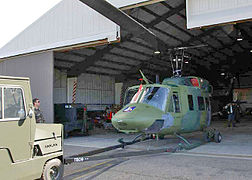
Hangars can hold letadla s pevnými{0}křídly, rotační-letadlo (vrtulníky), and lehčí-než-letecké lodě.
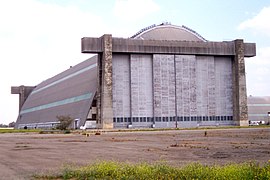
Hangár č. 2 at the former Letecká stanice námořní pěchoty Tustin is 1,072 ft (327 m) long, 292 ft (89 m) wide and 192 ft (59 m) tall.

Airbus A319 prochází údržbou v hangáru.
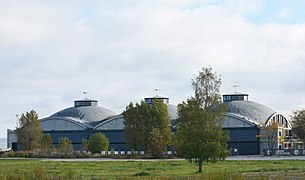
Hangars for hydroplány of the Ruské císařské letectvo in Tallinn harbor - some of the first železobeton structures

A General Dynamics F-16 Fighting Falcon in front of a Tvrzený letecký kryt, speciální typ hangáru
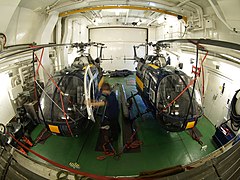
Helicopter hangar of the German research vessel polární hvězda

A medium-sized aircraft hangar at Letiště Kemble, Anglie

Hangar of Iberia Airlines (XXL-150m span) Letiště v Barceloně, Španělsko
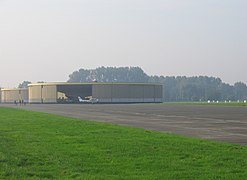
Round concrete hangars at Letiště Grimbergen, Belgie.


.jpg)
